Diving Into Design: Versatile Scuba Silhouettes
Understanding the Visual Language of the Collection
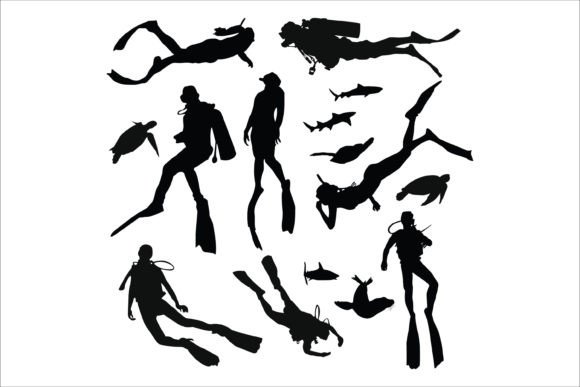
When you are building a visual identity for anything related to water sports, travel, or aquatic leisure, stock photography often feels too specific or too cluttered. That is exactly where Scuba Diving Silhouette Illustrations prove their worth. This collection isn't just a random assortment of shapes; it is a cohesive design asset library featuring a scuba diving silhouette vector illustration isolated on a white background. The imagery captures the essence of sport underwater, whether you are representing a murky lake, the open sea, or a professional training facility. The style relies on high-contrast black shapes that immediately communicate the subject without the distraction of facial features or complex textures.
What makes this particular set stand out is the attention to essential gear details. You will find accurate representations of the glove and flashlight, the distinct shape of the mask, and the curve of the snorkel. These elements are crucial for realism. If you are a designer working on a project for a diving school or a beach fun event, generic stick figures won't cut it. You need vectors that respect the anatomy of the sport. The file delivery is robust, including 1 AI File, 1 EPS File, 1 SVG File, 1 Transparent PNG File, and 1 JPGE File. This ensures that whether you are scaling up for a billboard or shrinking down for a mobile app icon, the resolution remains crisp.
Strategic Applications for Modern Brands
For the entrepreneur or small business owner, the utility of these illustrations goes far beyond simple decoration. Consider the psychology of the silhouette. Because the figure is dark and lacks internal detail, it acts as a universal avatar. It allows your audience to project themselves into the image. This is a powerful tool for brand identity. When you use a scuba silhouette on a logo design for a charter boat company, you aren't showing a specific person; you are showing the concept of diving. This inclusivity broadens your market appeal.
Here are practical ways to integrate these assets into your workflow:
- Editorial Design & Publishing: If you are a blogger or publisher writing about marine biology or vacation planning, these vector illustrations serve as excellent spot graphics. They break up text-heavy pages without demanding the color management required by photographs. Use the transparent PNG to layer the diver over a textured background in your magazine layout.
- Packaging Design: For products like waterproof phone cases, dive watches, or reef-safe sunscreen, the silhouette style offers a modern, minimalist aesthetic. It pairs exceptionally well with bold typography. The simplicity of the black vector ensures that even on small packaging, the graphic remains legible.
- Digital & Web Design: Website headers often suffer from "generic stock photo syndrome." A custom header featuring a layered composition of these silhouettes—perhaps a swimmer in the foreground and a distant boat in the background—creates depth. The SVG file is particularly useful here, allowing for fast loading times and crisp rendering on retina displays.
- Social Media Graphics: Consistency is key for content creators. You can create a series of templates using these illustrations. For a fishing guide or a swimming instructor, using a consistent style of silhouette across Instagram stories and Facebook posts builds recognition. It signals professionalism before the viewer even reads the caption.
Design Mechanics and Creative Execution
While these are illustrations rather than a premium font, the principles of modern typography and layout apply directly to how you use them. Think of these silhouettes as a display typeface with a very specific personality. Just as you would pair a script font with a sans serif font for contrast, you should pair these detailed silhouettes with clean, legible type. If you use a complex, handwritten font over a busy silhouette composition, the result will be visual chaos. Instead, let the graphic breathe. Use a bold, geometric typeface for headlines to match the structural rigidity of the diving gear.
One common mistake in packaging design and web design is treating vectors as untouchable. Do not be afraid to manipulate the provided files. If you are working in Adobe Illustrator, you can ungroup the EPS or AI files to change the color of the wetsuit or the flashlight beam to match your brand's color palette. You can also combine elements. For instance, take the mask and snorkel from one vector and combine it with the body position of another to create a unique pose that fits your specific layout needs.
Visual hierarchy is another critical consideration. The "Sport underwater" and "Beach fun" themes suggest high energy. To maintain readability in a poster or flyer, use the silhouette as a background element with reduced opacity or as a solid anchor point in the corner. This draws the eye toward the center where your commercial font headlines and calls to action reside. Remember, the goal of creative font usage and vector integration is to guide the viewer’s eye, not trap it.
Technical Flexibility and File Management
For the hobbyist or crafter, the availability of the Transparent PNG File is a massive advantage. If you are designing a t-shirt for a local dive club or creating stickers, you can drop the image directly into software like Canva or Procreate without needing to know how to remove backgrounds. The isolation on a white background means the edges are clean, which is vital for print quality.
However, for professional applications—such as large format printing or intricate logo design—the vector formats (AI, EPS, SVG) are non-negotiable. These files allow for infinite scalability. You can zoom in on the glove and flashlight to the pixel level, and the lines will remain sharp. This is the difference between an amateur project and a professional one. When you are pitching a rebrand to a diving school, showing them a crisp vector mockup demonstrates technical competence.
Finally, consider the context of the environment. The prompt mentions lake and sea. While the silhouette is generic, you can use the environment to dictate the mood. If your project is about cold-water lake diving, pair the silhouettes with cool blues, grays, and a sturdy serif font to imply stability and history. If it is about tropical sea adventures, use vibrant teals, coral, and a dynamic display font. By adapting the context around the illustration, you keep the content fresh and relevant to your specific audience, ensuring high engagement and a cohesive brand identity.